
 Wildlife
of China
Himalayan Takin
Wild Cattle & Serow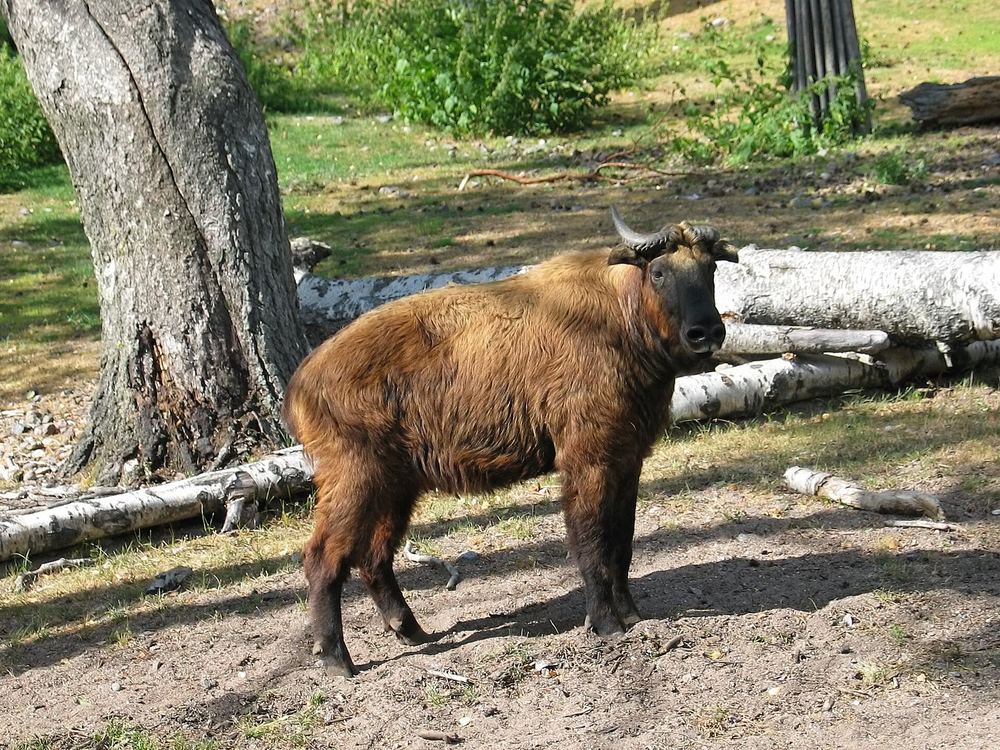
Photo: -Majestic- · CC BY-SA 3.0
Budorcas taxicolor
Basic stats
Diet
Leaves, grasses, herbs, twigs, and evergreen foliage
Habitat
Forested valleys, mountain woodland, and alpine grassland
Range
Eastern Himalayas, Tibet, and central and southern China; 1,000–4,250 m
Litter size
Usually 1 calf
Gestation period
Approximately 6.7–7.3 months
Size
170–220 cm long
Weight
150–400 kg
The takin is a massive, shaggy bovid with a large head, arched muzzle, broad naked nose, and short powerful legs. Its coat varies from whitish or golden yellow to reddish brown and carries a dark dorsal stripe. Both sexes have thick, ribbed horns that emerge close together, turn sharply outward, then sweep backward and upward. Adult males reach 210–220 cm long and are substantially larger than females. (Animal Diversity Web)
Takins range from eastern Tibet and central and southern China through Bhutan, northeastern India, and northern Myanmar. They inhabit forested valleys, mountain woodland, and rocky alpine grassland at 1,000–4,250 m, migrating upward during summer and downward in winter. Summer herds may contain as many as 300 animals. These generalist browsers eat leaves, grasses, herbs, twigs, and evergreen foliage and travel to mineral deposits. Usually one calf follows a gestation of roughly seven months. (Animal Diversity Web)
Quick answers
- What does the Himalayan Takin eat?
- Leaves, grasses, herbs, twigs, and evergreen foliage
- What habitat does the Himalayan Takin live in?
- Forested valleys, mountain woodland, and alpine grassland
- Where is the Himalayan Takin found?
- Eastern Himalayas, Tibet, and central and southern China; 1,000–4,250 m
- What is the litter size of the Himalayan Takin?
- Usually 1 calf
- How long is the gestation period of the Himalayan Takin?
- Approximately 6.7–7.3 months
- How big is the Himalayan Takin?
- 170–220 cm long
- How much does the Himalayan Takin weigh?
- 150–400 kg